JevAlt
JevAlt is a family of open decision models that speak TypeSafe's Jev API. Give it a state and typed questions; it returns a calibrated probability for every option. It runs on your own machine in 4 GB of RAM (measured peak 3.0 GB for the Q4_K_M builds at 4k context).
| Model | Language | Hugging Face |
|---|---|---|
| Deem-4B | English | mertkayacs/Deem-4B |
| Karar-4B | Turkish | mertkayacs/Karar-4B |
| Wähler-4B | German | mertkayacs/Wahler-4B |
Each model has a GGUF build next to it (-GGUF). The jevalt server runs it on a CPU and answers the Jev API; it reads the model's next-token probabilities at each decision, which plain chat servers do not expose.
Three question types
- Choice picks one option from a set you define and returns a probability for each.
- Score rates the state on an ordered rubric and returns the expected level plus the distribution.
- Noul answers a yes/no question with the probability of yes.
Your code acts on the numbers. A 0.97 can go straight through; a 0.55 can go to a person.
What JevAlt adds
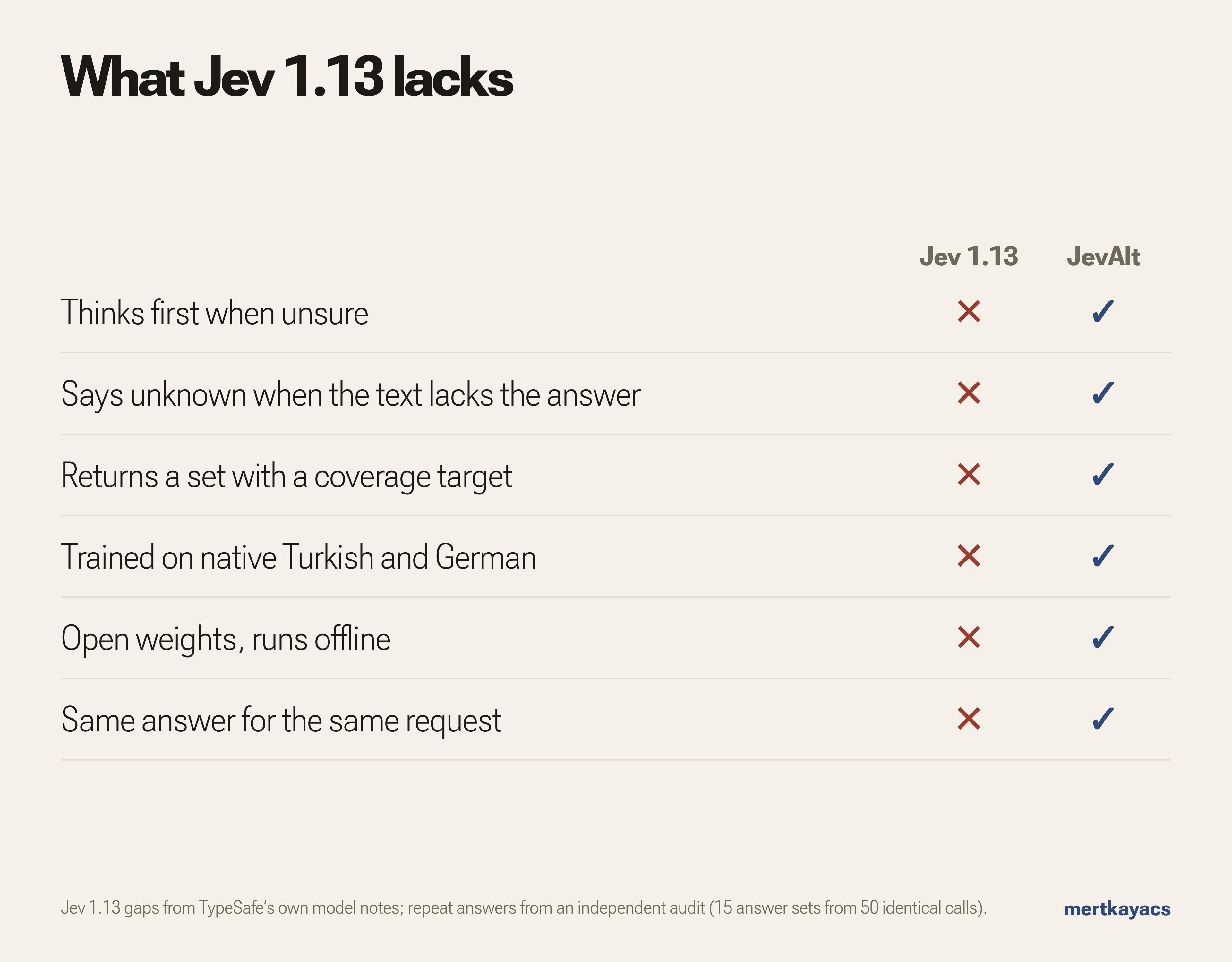
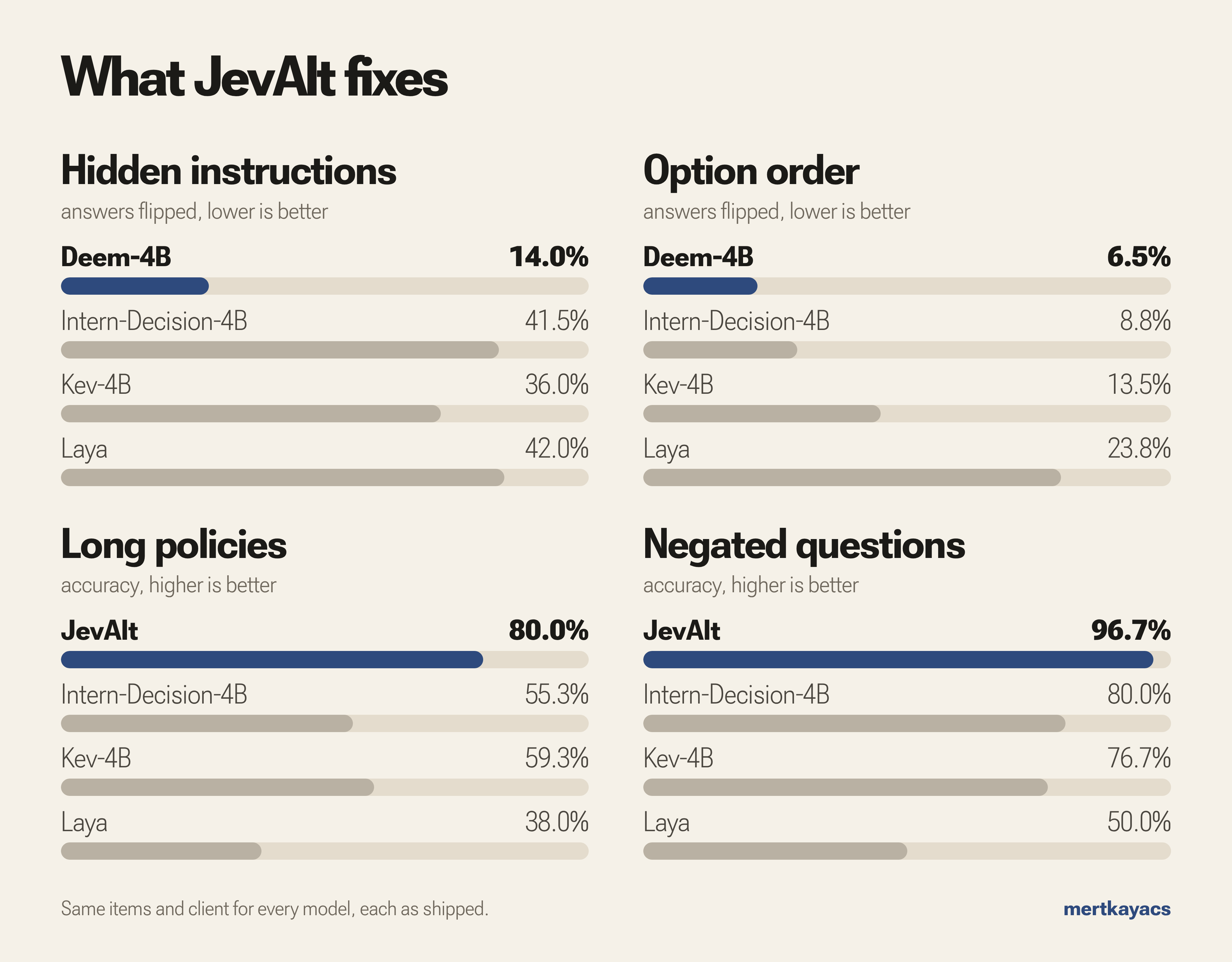
Turn the extras on per request with reasoning: "auto", abstain: true and coverage: 0.9. The Jev 1.13 rows come from TypeSafe's notes and an independent audit. The measured numbers behind each row are on the model cards and in the JevOss reports.
Start
pip install "jevalt[serve,gguf] @ git+https://github.com/mertkayacs/jevalt"
jevalt serve
Then send any Jev request to http://127.0.0.1:8000/v1/systemone. The API page has the full contract, Reasoning explains the modes, and Run locally covers memory and speed.
If JevAlt saves you time, a star on GitHub helps others find it.